

Mid-market commercial insurance brokers are increasingly confronting the limitations of traditional Agency Management Systems (AMS), which often necessitate significant manual intervention despite substantial investments. This operational reality sees brokers spending up to 45% of their time on manual data entry, diverting focus from strategic client engagement according to Insurance Business Magazine.
The prevailing “bolt-on AI” approach, attempting to graft new AI capabilities onto legacy AMS platforms, is proving insufficient in 2026 due to inherent data fragmentation and escalating compliance risks. This article will demonstrate the compelling business case for migrating to agentic AI solutions, highlighting the fundamental architectural shift they represent and the tangible outcomes brokers can expect.
What Agentic AI Actually Means for Insurance Broking
Agentic AI refers to autonomous AI agents capable of executing multi-step workflows independently, without requiring human intervention at each decision point as described by Druid AI. This differs significantly from traditional automation or chatbots, which primarily execute predefined tasks or respond within narrow parameters.
Agentic AI agents possess decision-making capabilities, allowing them to adapt to changing contexts and process complex inquiries more effectively than rule-based systems notes Wadline. For insurance brokers, three core capabilities are paramount:
- Intelligent Document Processing: Autonomous extraction and interpretation of data from diverse documents, such as policy schedules, claims forms, and underwriting submissions.
- Dynamic Risk Assessment: Real-time evaluation of commercial risks by synthesizing internal and external data, informing underwriting decisions and pricing.
- Automated Bordereaux Management: Autonomous processing, reconciliation, and validation of complex premium and claims bordereaux.
True agentic AI necessitates an AI-native platform architecture, as legacy systems struggle to provide the unified data models and flexible integration required for these advanced capabilities Agiliux platform.
The Hidden Costs of Legacy AMS Platforms
Legacy AMS platforms, despite their initial investment, impose significant hidden costs that erode broker profitability and operational efficiency. The “Excel tax” symbolizes the time and error costs associated with managing critical data outside the primary system of record.
Technical debt accumulates as bolt-on integrations create exponential maintenance costs, leading to a complex and fragile IT ecosystem according to Coasty.ai. Furthermore, fragmented data models increase compliance exposure, posing significant regulatory risks in 2026’s stricter environment highlights nCino.
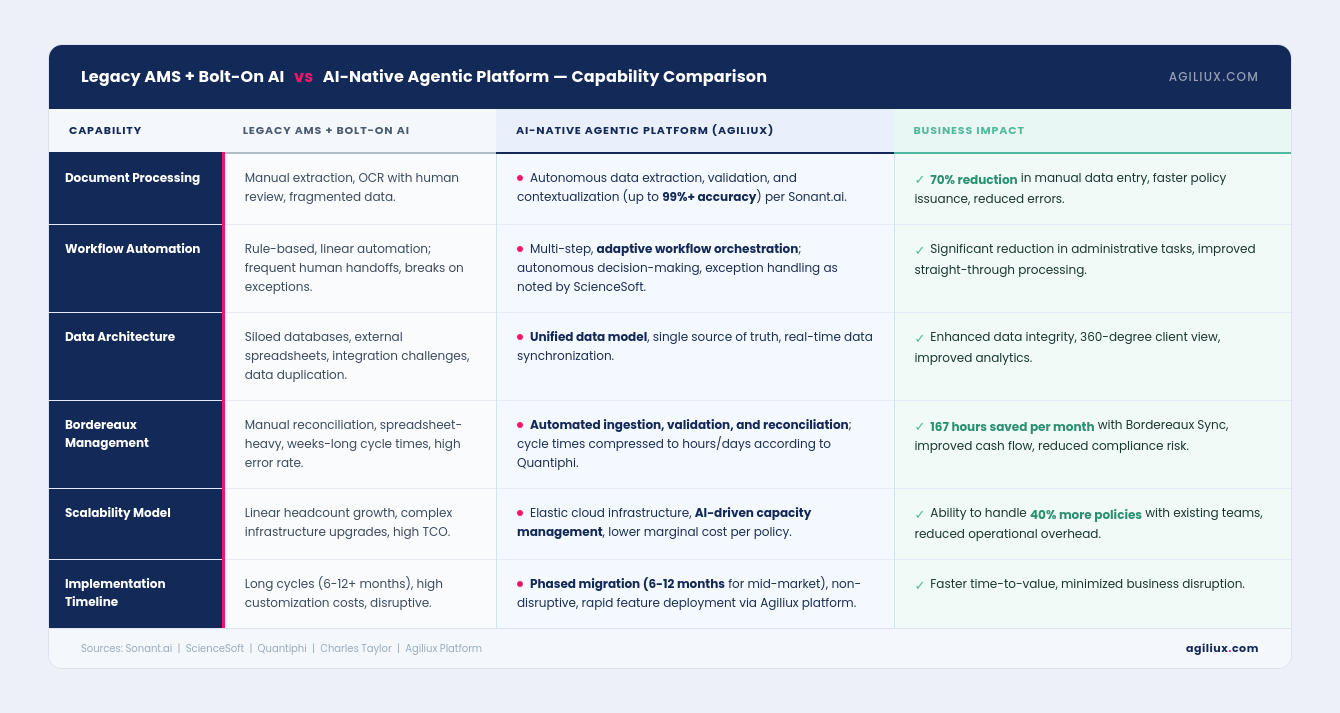
The total cost of ownership (TCO) for legacy AMS platforms, when factoring in these hidden expenses, significantly exceeds that of AI-native solutions over a three-year period. IT costs per policy are 41% higher on legacy platforms compared to modern core systems a Grid Dynamics blog indicates.
Here is a comparison:
Five Business Outcomes Driving the Switch to Agentic AI
The shift to agentic AI platforms is driven by compelling business outcomes that directly impact broker profitability and service quality.
Outcome 1: 60-70% reduction in policy administration time through autonomous document processing
Agentic AI automates the ingestion, classification, and data extraction from diverse policy documents with over 99% accuracy per Sonant.ai. This frees up significant broker time, allowing them to focus on client advisory rather than manual data entry.
- Automated document processing cuts verification times by approximately 85% reports WNS.
- Brokers save 5-10 hours per agent per week on administrative tasks according to Sonant.ai.
- This efficiency enables agencies to handle increasing policy volumes without proportional headcount growth.
Outcome 2: Real-time risk assessment enabling same-day quote turnaround for complex commercial risks
Agentic AI platforms synthesize vast amounts of internal and external data, including IoT and telematics, to provide dynamic risk scoring as highlighted by CFC. This capability drastically reduces underwriting decision times.
- Underwriting automation can cut decision times from 3-5 days to as little as 12.4 minutes reports Sonant.ai.
- Complex commercial and specialty P&C quotes can be delivered in one to two hours, instead of days per McKinsey.
- This speed provides a significant competitive advantage in a softening market according to Send Technology.
Outcome 3: Automated bordereaux scheduling eliminating month-end reconciliation bottlenecks
Agentic AI agents autonomously manage the entire bordereaux process, from data ingestion and validation to reconciliation and submission. This eliminates manual errors and accelerates financial close processes as detailed by Insurnest.
- Bordereaux cycle times can be compressed from weeks to hours or days Quantiphi indicates.
- Teams using AI-powered tools like Bordereaux Sync can save up to 167 hours per month reports Charles Taylor.
- Automated checks for errors ensure compliance and reduce rejections, particularly for Lloyd’s coverholders notes Regure.
Outcome 4: Enhanced client experience through instant policy queries and self-service portals powered by AI agents
AI-powered platforms provide 24/7 client support, handling routine inquiries, providing policy-specific context, and enabling self-service options according to NextLevel.AI. This frees brokers to focus on complex advisory roles.
- 80% of routine customer interactions can be automated with AI platforms.
- Clients receive faster, more accurate service, leading to increased satisfaction and retention per Nationwide Agent Blog.
- Proactive risk alerts and personalized recommendations strengthen client relationships MyAIFrontDesk suggests.
Outcome 5: Scalability without proportional headcount growth – handling 40% more policies with existing teams
By automating core operational tasks, agentic AI platforms allow brokers to expand their book of business and serve more clients without needing to linearly increase staff. This drives significant efficiency gains and improved profit margins.
- AI-driven automation delivers 20-30% productivity gains in insurance functions McKinsey estimates.
- Mid-market brokers can achieve 10-15% premium growth and 20-40% reduction in customer onboarding costs as per BrokerTech Ventures.
- This enhanced capacity allows brokers to pursue larger, more complex accounts and grow strategically.
How Mid-Market Brokers Are Managing the Migration
Migrating from a legacy AMS to an agentic AI solution is a strategic undertaking that mid-market brokers are approaching with a phased methodology. This minimizes disruption and maximizes the adoption of new capabilities.
- The Phased Approach: Brokers typically start by migrating the highest-pain processes, such as bordereau management or renewals processing, rather than attempting a full system replacement advises ZTABS. This allows teams to gain familiarity and demonstrate early ROI.
- Data Migration Strategies: Ensuring historical policy data integrity is crucial during the transition. Strategies involve careful data cleansing, mapping, and validation to ensure seamless transfer to the AI-native architecture.
- Staff Training and Change Management: Repositioning brokers as strategic advisors, rather than data processors, requires comprehensive training and change management programs. This focuses on leveraging AI tools for deeper client insights and more effective negotiation.
- Timeline Expectations: Realistic migration paths for mid-market brokers generally span 6-12 months for full CRM integration and custom workflows according to DyadTech. A basic AMS setup can take 2-8 weeks reports Vantagepoint.io.
Evaluating Agentic AI Platforms: What Brokers Should Demand
When evaluating agentic AI platforms, brokers must look beyond superficial AI features and demand core architectural capabilities. Agiliux Cloud Insurance, for instance, embodies these critical requirements as an AI-native solution. Explore insurance brokers.
Core requirement 1: True AI-native architecture, not retrofitted AI on legacy code
A genuine AI-native platform is built from the ground up to leverage AI, rather than attempting to bolt AI functionalities onto an outdated core system as exemplified by Agiliux. This ensures seamless integration, optimal performance, and future scalability.
- AI-native platforms offer superior performance and lower TCO compared to legacy systems with bolt-ons.
- They provide the foundation for advanced agentic capabilities and continuous innovation.
Core requirement 2: Autonomous agent capabilities for end-to-end workflow execution without human handoffs
The platform must support AI agents that can interpret goals, plan multi-step tasks, and execute workflows across different systems autonomously per Wadline. This eliminates bottlenecks and streamlines operations.
- True agentic solutions minimize human intervention, allowing brokers to focus on high-value client interactions.
- They adapt to exceptions and learn from new data, continuously improving efficiency.
Core requirement 3: Unified data model eliminating the need for external spreadsheets and reconciliation
A single, unified data model is essential to prevent fragmentation and ensure data integrity. This eliminates the “Excel tax” and provides a 360-degree view of clients, policies, and operations.
- This architecture supports real-time analytics and accurate reporting.
- It drastically reduces reconciliation efforts and associated errors.
Core requirement 4: Regulatory compliance built into the platform architecture, not added as an afterthought
In 2026, regulatory compliance, particularly under the FCA’s Consumer Duty in the UK, demands data-driven governance and transparent processes as noted by Fintech.global. An AI-native platform should have compliance features embedded from design.
- The platform should offer robust audit trails, data privacy controls, and adherence to standards like ISO 27001, SOC 2, and GDPR as provided by Agiliux.
- Automated compliance checks and reporting reduce regulatory risk and operational burden.
Brokers should ask vendors how their “AI” solutions differ from traditional automation and whether they offer truly autonomous, multi-step agentic capabilities.
Conclusion: The Strategic Imperative for 2026 and Beyond
The decision to migrate from a legacy AMS to an agentic AI solution is no longer merely about operational efficiency; it is a strategic imperative for competitive positioning. Brokers who embrace AI-native platforms are gaining a significant advantage, winning business from those still reliant on outdated systems according to Risk & Insurance.
The market reality of 2026 clearly shows that brokers with AI-native platforms are outperforming their peers. First-movers in this space are poised to gain an 18-24 month advantage in operational maturity and client service capabilities, fundamentally reshaping the commercial insurance landscape.
For brokers evaluating this switch, the next step involves assessing current pain points, understanding the capabilities of true agentic AI platforms like Agiliux broking solution, and planning a phased migration to unlock these transformative benefits.
Key Takeaways
- Legacy AMS platforms create significant hidden costs and operational inefficiencies, including high manual data entry time.
- Agentic AI offers autonomous, multi-step workflow execution, fundamentally differing from traditional automation.
- Key business outcomes include 60-70% reduction in policy administration and real-time risk assessment.
- Mid-market brokers are adopting phased migration strategies for smoother transitions to AI-native platforms.
- Evaluating platforms requires demanding true AI-native architecture, autonomous agents, unified data models, and built-in regulatory compliance.
- The switch to agentic AI is a competitive necessity, offering first-movers a significant market advantage.
Frequently Asked Questions
What is agentic AI and how is it different from regular AI in insurance?
Agentic AI refers to autonomous AI agents that can execute complex, multi-step workflows independently without human intervention. This differs from regular AI, which typically requires human oversight for each decision point or operates within predefined, narrower tasks, such as chatbots reacting to specific queries.
How long does it take to migrate from a legacy AMS to an AI-native platform?
For mid-market brokers, a realistic migration timeline from a legacy AMS to an AI-native platform typically ranges from 6 to 12 months. This often involves a phased approach, where critical processes like bordereau management or renewals are migrated first, while the legacy system temporarily runs in parallel.
What is the ROI of switching from traditional AMS to agentic AI solutions?
Switching to agentic AI solutions offers substantial ROI, including a 60-70% reduction in administrative time, significant error reduction, and scalability to handle 40% more policies without proportional headcount growth. These benefits lead to a competitive advantage and a rapid payback period, with some automation showing 270% ROI over three years per Businesswire. Explore why brokers choose Agiliux.
Can agentic AI platforms integrate with our existing carrier connections and data sources?
Yes, agentic AI platforms are designed with API-first architecture and unified data models to seamlessly integrate with existing carrier connections and diverse data sources. This approach eliminates the manual reconciliation often required with legacy systems, providing a single, consistent view of all data.
How much does an AI-native platform cost compared to maintaining our current AMS?
While the upfront perception may vary, AI-native platforms often present a lower total cost of ownership (TCO) compared to maintaining a legacy AMS plus bolt-ons. Legacy systems incur high costs for licensing, integration, maintenance, and the hidden expense of manual workarounds, whereas modern platforms offer more predictable, often subscription-based pricing models with lower operational overhead as seen with Thunai’s $99/month flat rate.
Key Terms Glossary
Agency Management System (AMS): A software system used by insurance agencies to manage client information, policies, claims, accounting, and other operational tasks.
Agentic AI: Artificial intelligence systems featuring autonomous agents that can plan, execute, and adapt multi-step tasks without human intervention, making decisions based on their environment.
AI-Native Platform: A software platform built from the ground up with AI capabilities as a core architectural component, rather than adding AI as an afterthought to existing legacy systems.
Bordereaux Management: The process of managing and reconciling detailed reports of premiums, claims, or other data exchanged between coverholders or brokers and insurers, particularly in the London market.
Technical Debt: The cost incurred in future development and maintenance due to choosing an easy, but suboptimal, solution now instead of a better approach that would take longer.
Total Cost of Ownership (TCO): A financial estimate that calculates the direct and indirect costs of a product or system over its entire lifecycle, beyond just the purchase price.
Intelligent Document Processing (IDP): AI-powered technology that automates the extraction, understanding, and processing of data from structured, semi-structured, and unstructured documents.