Any Document. Any Data. Fully Automated.

Automate the ingestion, extraction, classification and use of all your insurance documents seamlessly and securely.
Agiliux Data and Document Automation is an AI-enabled capability that automates the extraction, classification, validation, and processing of insurance submissions, bordereaux, and claims documentation. It reduces manual handling, improves processing speed, and enhances operational accuracy for brokers and MGAs. This capability is foundational for organisations such as direct insurance brokers, reinsurance brokers, and insurance companies that process high volumes of policy documents, claims files, bordereaux, and compliance records daily.
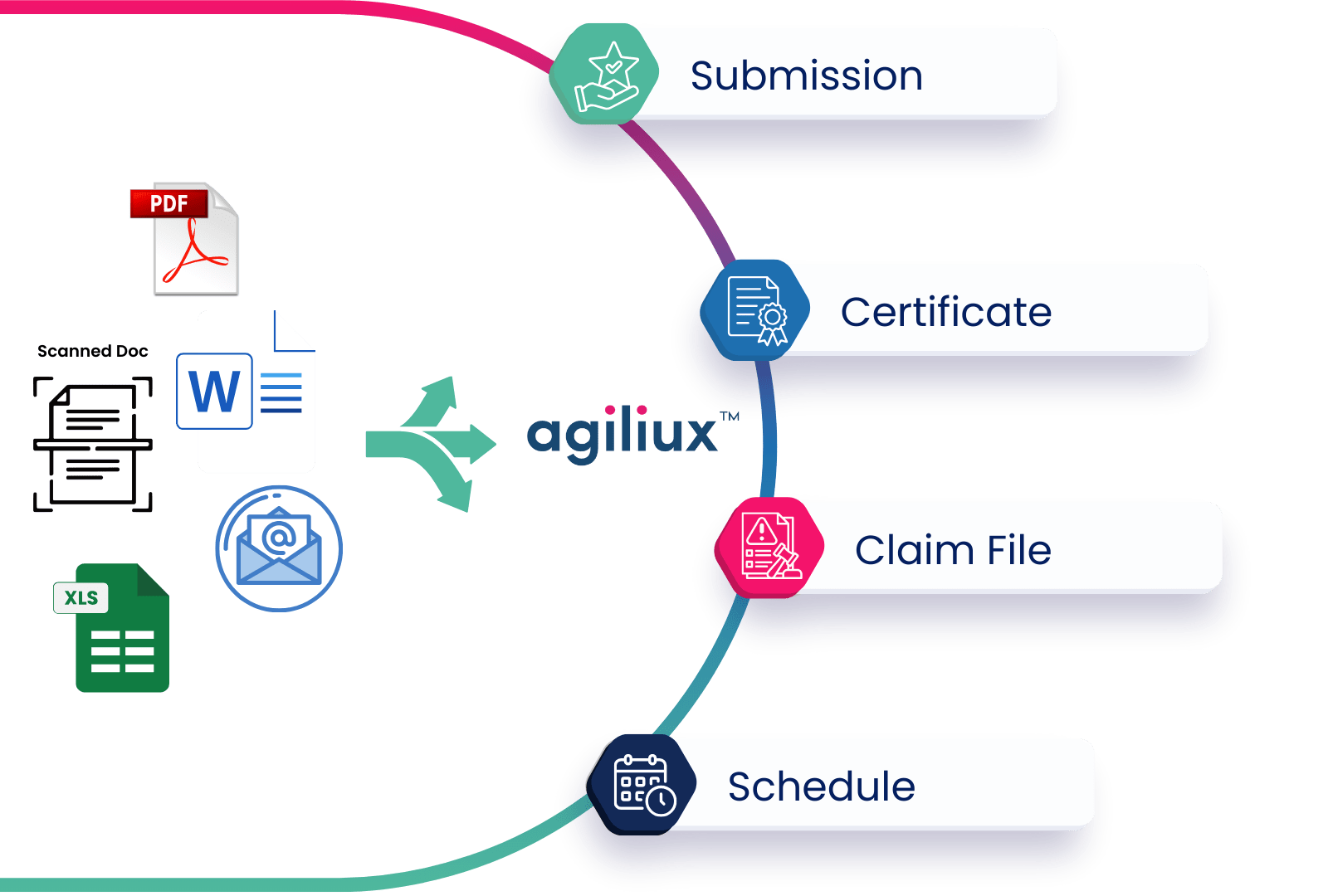
Document Ingestion & Classification
Ingest PDFs, Word files, Excel sheets, email attachments or scanned documents. The system classifies each into categories such as submission, certificate, claim file or schedule based on content and metadata. When integrated into a unified system of record, extracted data flows directly into underwriting, policy administration, and reporting workflows without manual re-entry.
Advanced Data Extraction
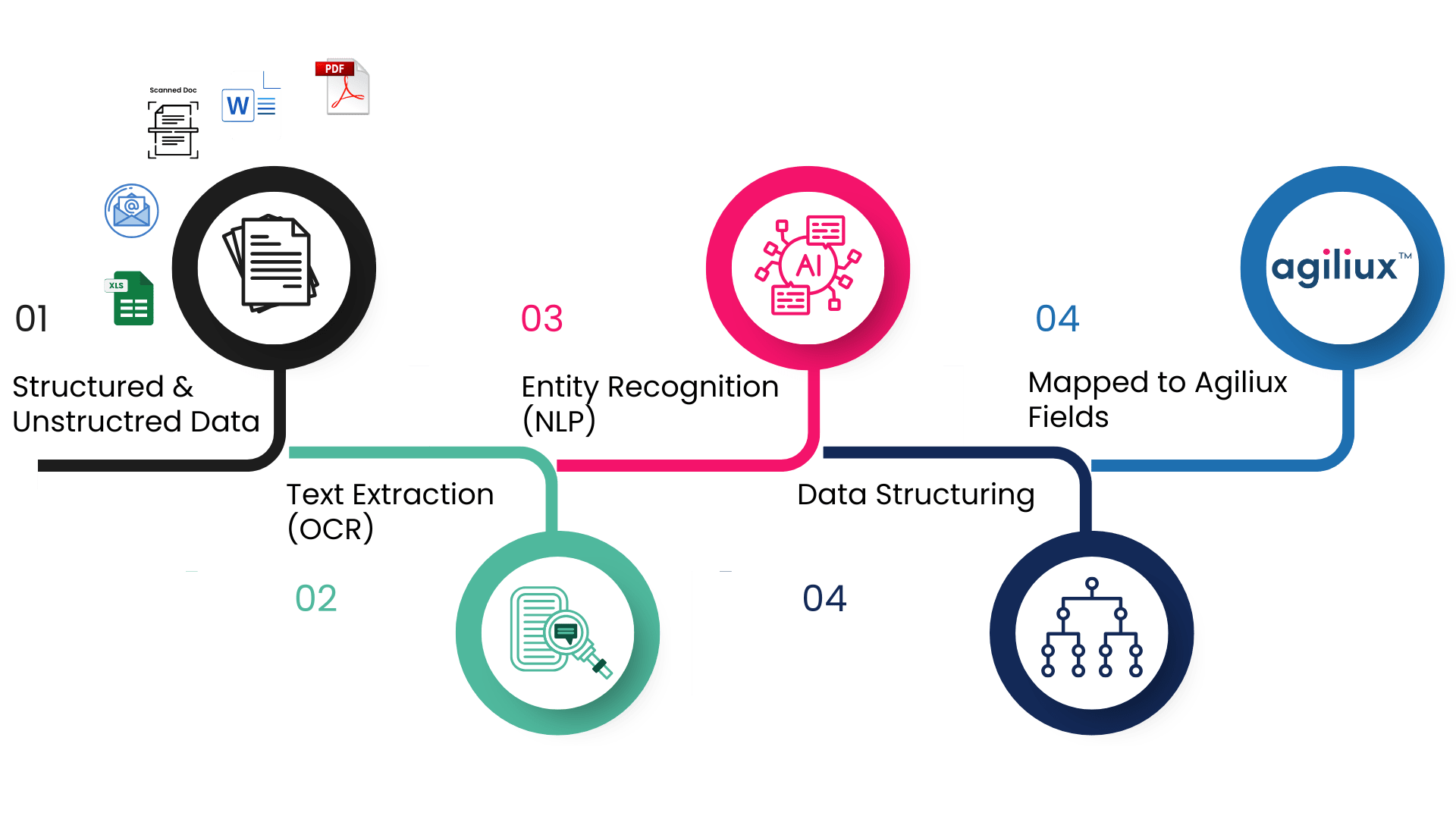
Use intelligent OCR and natural-language processing to pull structured and unstructured data from documents. Key risk variables, financial figures, policy details and claims data are identified, captured and mapped into the relevant fields in Agiliux.
Advanced Data Extraction
Use intelligent OCR and natural-language processing to pull structured and unstructured data from documents. Key risk variables, financial figures, policy details and claims data are identified, captured and mapped into the relevant fields in Agiliux.
Generate Documents
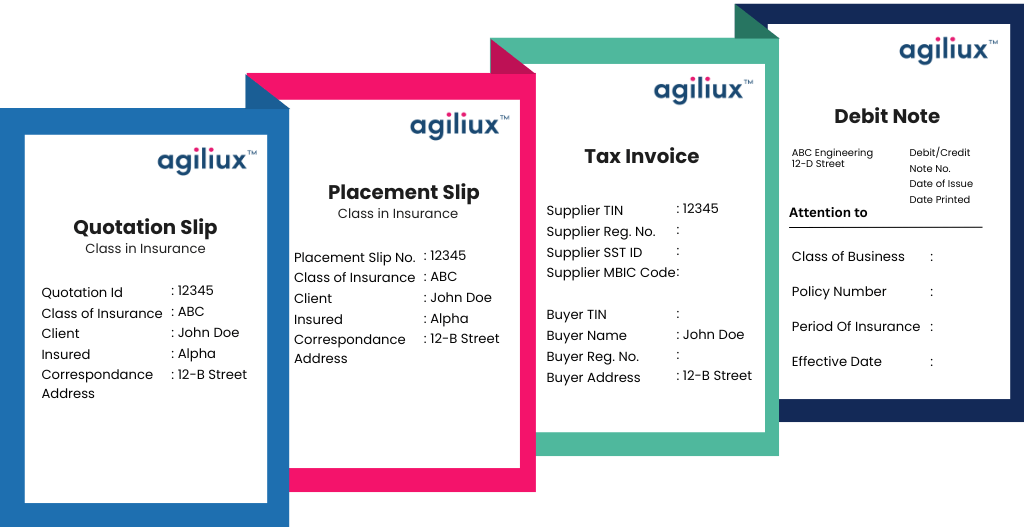
Agiliux creates all broker and MGA documents such as slips, quote comparisons, debit and credit notes, insurer invoices and statements. You can use templates for more than one hundred lines of business and customise them to your needs. For organisations requiring tailored document generation workflows or specialised outputs, our Agiliux Bespoke services help customise templates and processes to your business needs.
Agiliux manages every document and data type used in broking and MGA work. It ingests, extracts and structures information from submissions, schedules and bordereaux while preserving your workflows and full data ownership. This transforms static files into active intelligence.
Validation & Comparison
Compare incoming insurer quotes, certificates and placement slips. Automatically flag mismatches or missing data, such as coverage gaps or non-aligned terms, so your team can resolve issues quickly. This level of automated validation is especially valuable for complex underwriting environments and compliance teams, such as those at commercial insurance companies and reinsurance brokers.
Data Export & Ownership
You maintain full ownership of your data. Any data captured in Agiliux can be exported at any time via CSV, Excel or through APIs. This ensures long-term control and portability. For organisations focused on compliance and regulatory governance — such as banks with insurance distribution or bancassurance operations — owning and exporting structured data is a critical requirement.
Audit Trail & Compliance
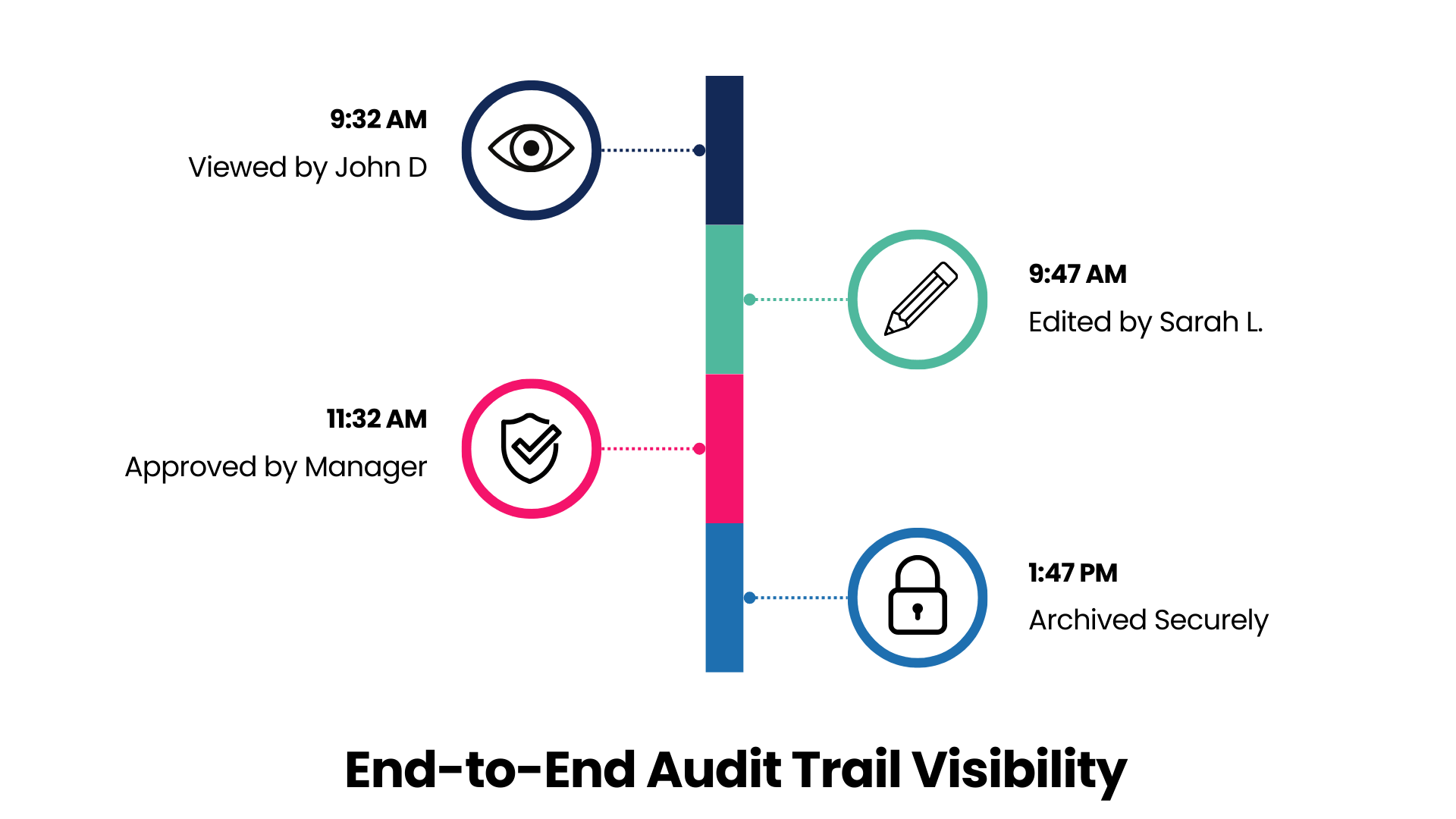
Every document action is versioned, time-stamped and fully auditable. You can track who viewed what, when and how data was changed to support regulatory reviews and internal governance.
Audit Trail & Compliance
Every document action is versioned, time-stamped and fully auditable. You can track who viewed what, when and how data was changed to support regulatory reviews and internal governance.
Custom Reporting & Analytics
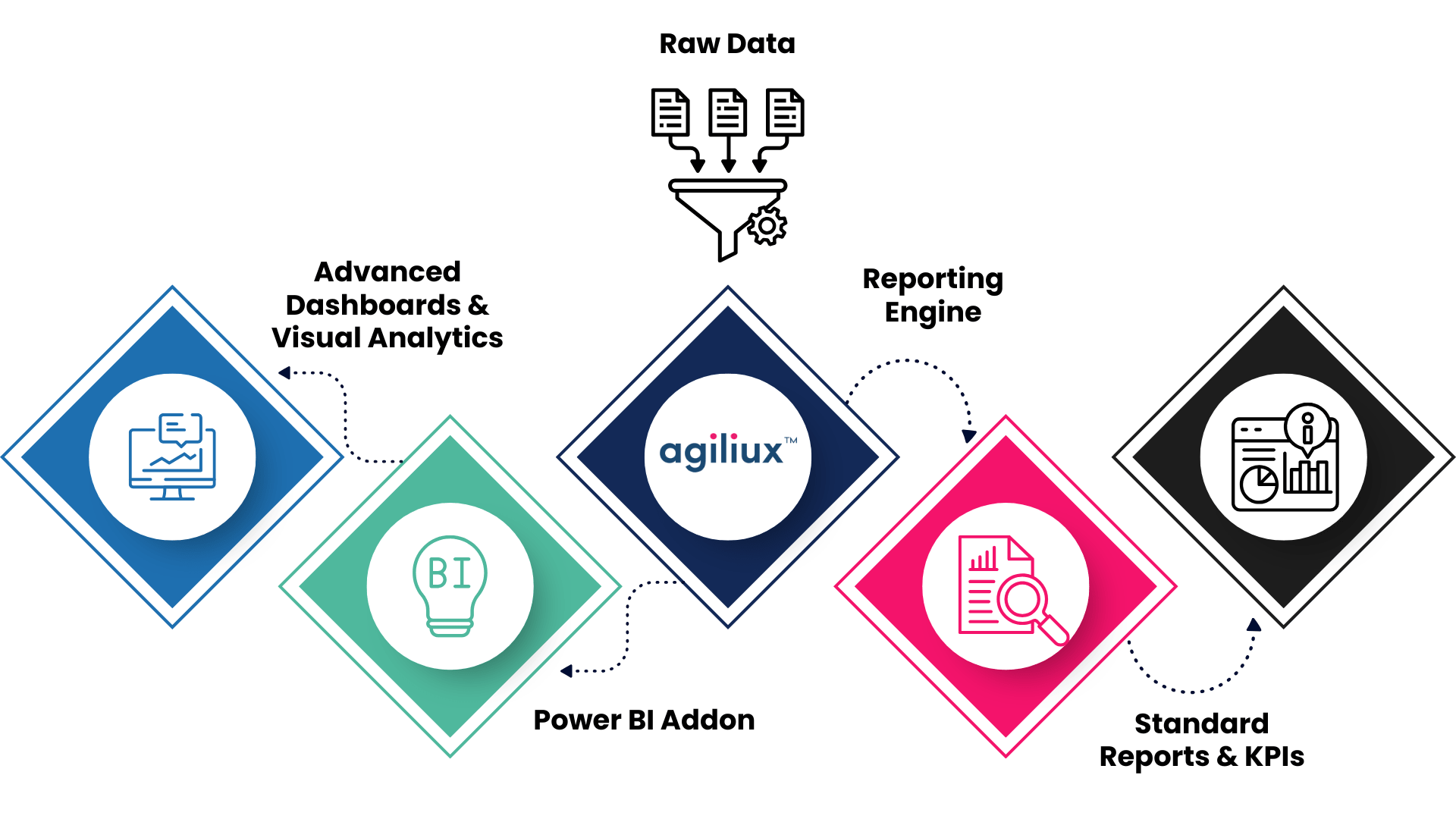
Generate built-in reports within Agiliux or leverage the Power BI add-on to build advanced dashboards and analytics for deeper insight. Visualise metrics such as quote-to-bind ratios, renewal performance, bordereaux trends and manual-process burden. Combined with strategic advisory via Agiliux Consulting, reporting dashboards and analytics can be designed to support executive decisions, governance reviews, and operational KPIs.
Frequently Asked Questions
How does "Document Intelligence" differ from standard OCR?
Standard Optical Character Recognition (OCR) merely converts images of text into machine-readable characters. Document Intelligence goes further by using Natural Language Processing (NLP) to “understand” the context. For example, it doesn’t just see a date; it identifies it as the “Policy Effective Date” or “Claim Date” and maps it to the correct field in the core system, ensuring the data is immediately actionable.
Can document automation handle handwritten claim forms or low-quality scans?
Modern AI-native engines use advanced image processing to clean up low-quality scans and can often interpret clear handwriting. While complex or illegible documents may still require human review, the system significantly reduces the volume of manual entry, flagging only “edge cases” for specialist intervention.
What is the "Golden Thread of Data" in document automation?
This refers to a seamless flow of data where information captured once—at the point of risk submission or quote—is reused throughout the entire policy lifecycle. This eliminates the need for re-keying information for policy issuance, mid-term adjustments, or claims, which reduces errors and ensures that the “single source of truth” remains accurate and consistent.
How does automated document comparison reduce errors in placement?
The system can automatically compare the details on a placement slip with the final quote and certificate issued by an insurer. It flags any discrepancies in premiums, limits, or terms, allowing the broker or MGA to catch errors before they lead to potential “Professional Indemnity” claims or customer dissatisfaction.
Is it possible to automate the extraction of data from complex Excel bordereaux?
Yes. For MGAs receiving data from sub-brokers or TPAs, the platform can ingest Excel files, map the columns to the internal system’s fields, and validate the data against predefined rules. This transforms the monthly “data headache” into a streamlined, automated workflow that feeds directly into the firm’s reporting and accounting modules.
How does document automation support "Bespoke" or niche risk placement?
In niche markets, submissions are often non-standard and data-heavy. Automation allows underwriters to quickly extract and summarize the critical information from these complex files. This enables faster triaging, allowing human specialists to focus their time on the intellectual task of risk assessment rather than the clerical task of data extraction.
Why this matters?
Manual document and data handling is not only time-consuming but also prone to error. By automating these critical workflows, Agiliux frees up your team to focus on negotiation, client engagement and value-add activities instead of admin. And with full data ownership and export capability, you remain in control always.